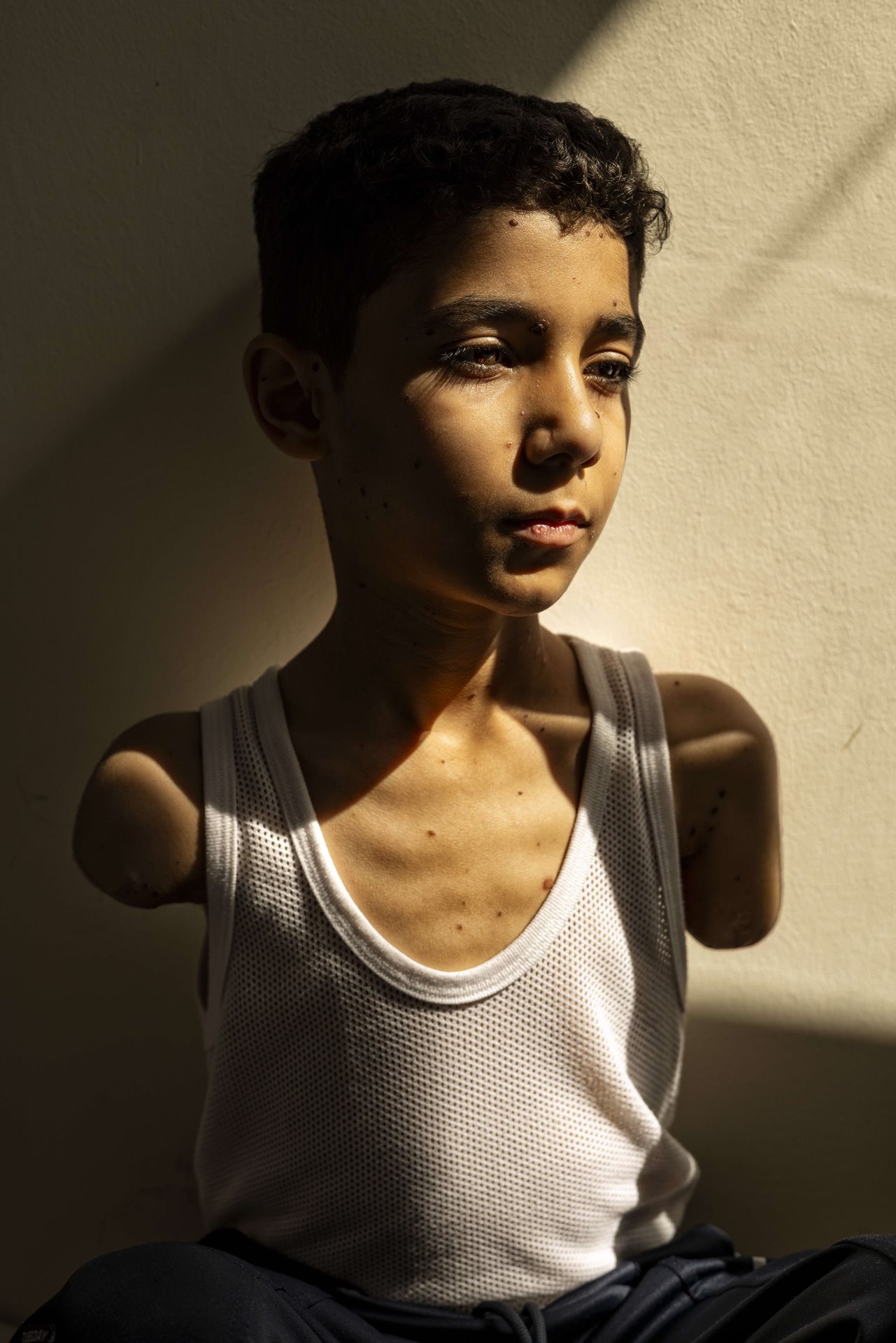
The photograph shows a mother cradling her son. His limbs are thin, his belly distended in the way that marks severe acute malnutrition — the body consuming its own muscle for fuel. Nada Al-Kanoo waits outside a field clinic in Khan Younis, hoping for a medical transfer that may or may not materialise.
Her son, Amjad, was among thousands of children in Gaza whose nutritional status deteriorated catastrophically during the blockade. UNICEF and the World Health Organisation had already classified northern Gaza as experiencing famine-like conditions by early 2024; by mid-year, the crisis had spread south.
What makes the Al-Kanoo case emblematic is its ordinariness within the context of the war. Nada is not a combatant. Amjad is not collateral damage in any military sense. They are a mother and child caught inside a system where food supply chains collapsed, where medical logistics broke down, where the infrastructure of survival — markets, bakeries, water treatment, hospitals — ceased to function.
The images of Amjad were published globally by Reuters and shared across social media millions of times. They prompted renewed calls for humanitarian corridors and ceasefire, and were referenced in multiple UN Security Council sessions.
Amjad's face became, for many, the face of a generation of children who may carry the physical and developmental consequences of this period for the rest of their lives — assuming they survive it.