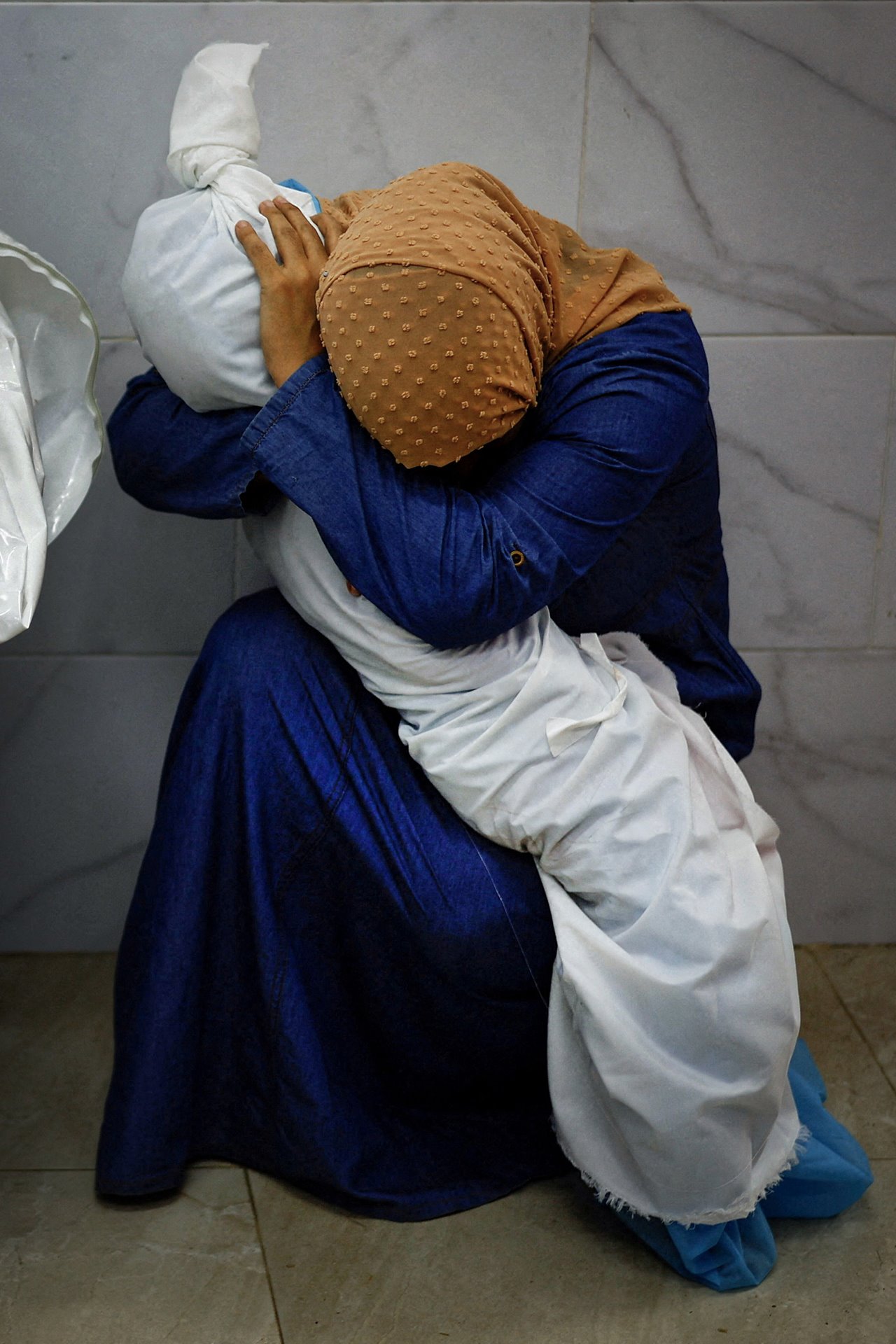

The photograph that would win the 2024 World Press Photo of the Year shows a woman in a hospital morgue, her body curved around a small form wrapped in a white shroud. She is pressing her face against the child's. Her eyes are closed. The tenderness of the gesture — a final embrace rendered in the fluorescent light of a morgue — stopped the world.
The woman is Inas Abu Maamar. The child is her five-year-old niece, Saly. They are in the Nasser Hospital in Khan Younis, Gaza, in October 2023. Photographer Mohammed Salem of Reuters captured the image in the hours after an Israeli airstrike hit the building where Inas's family had sought shelter.
Inas had been close to Saly since the girl was born. In interviews, relatives described the bond between aunt and niece — how Saly would climb into Inas's lap unprompted, how Inas would braid her hair each morning, how the two were inseparable in the days after the family displaced to Khan Younis. When Saly was killed, Inas went to the morgue and would not leave.
Mohammed Salem, the photographer, later described the moment with the restraint of someone who has witnessed too much. He had been documenting the dead arriving at Nasser Hospital for days. He saw Inas enter, saw her find Saly, and watched her fold herself around the child. He raised his camera. The image he made is simultaneously intimate and universal — a document of one woman's grief that carries the weight of tens of thousands of similar moments that no camera recorded.
The photograph was published globally within hours. It appeared on front pages from Tokyo to New York, was shared millions of times on social media, and eventually became the centrepiece of the World Press Photo exhibition. The judges described it as an image that conveyed the full human cost of war through a single gesture.
Inas survived the war. Saly did not. The photograph exists now as both journalism and memorial — proof that in the vast arithmetic of casualties, each number held a name, and each name was loved.


