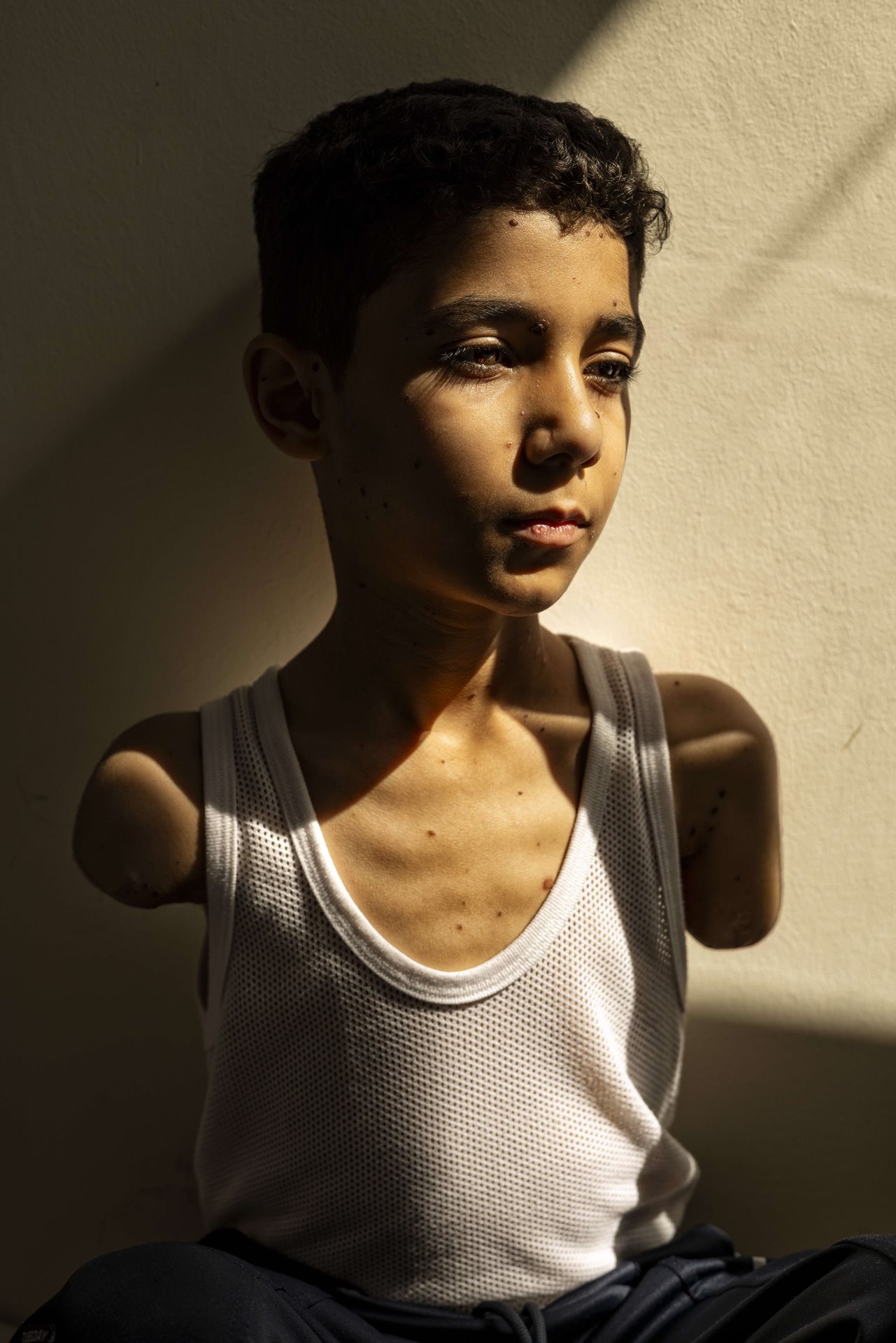

Mahmoud Ajjour was nine years old when shrapnel from an Israeli strike tore through his body in March 2024, destroying much of his lower abdomen and requiring the amputation of both legs. He was evacuated from Gaza to Qatar's Hamad Medical Corporation — one of a small number of children critically injured enough to qualify for medical transfer through the Rafah crossing before it was seized by Israeli forces.
The photograph of Mahmoud that would be recognised by the 2025 World Press Photo awards shows a small boy in a hospital bed, his face turned to the camera with an expression far older than his years. Samar Abu Elouf, a Palestinian photojournalist who had herself been displaced multiple times during the war, captured the image as part of a series documenting the medical aftermath of the bombing campaign.
Before the strike, Mahmoud was a boy who loved football. His family described him as energetic, competitive, always running. The irony is not lost on anyone who has followed his story — a child defined by movement, rendered immobile by a weapon likely manufactured thousands of miles from the pitch where he used to play.
His medical journey is a map of the war's cascading crises. Gaza's hospitals, systematically degraded by bombardment, lacked the surgical capacity to treat his injuries. The waiting list for medical evacuation grew into the thousands. By the time Mahmoud reached Doha, his condition had deteriorated significantly. Months of surgery and rehabilitation followed.
Mahmoud's case is one of thousands. UNICEF reported that by mid-2024, more than 1,000 children in Gaza had undergone amputations — many without adequate anaesthesia, in field conditions, by surgeons operating beyond exhaustion. The phrase 'wounded child, no surviving family' became so common in hospital intake records that medics abbreviated it: WCNSF.
In Qatar, Mahmoud began the long process of learning to live in a body that had been remade by war. Fitted with prosthetics, he took his first steps in a rehabilitation centre far from home. Photographers documented this too — the small victories that exist alongside the enormous losses. Mahmoud's story is not over. But it has already become part of the permanent record of what was done to the children of Gaza.


