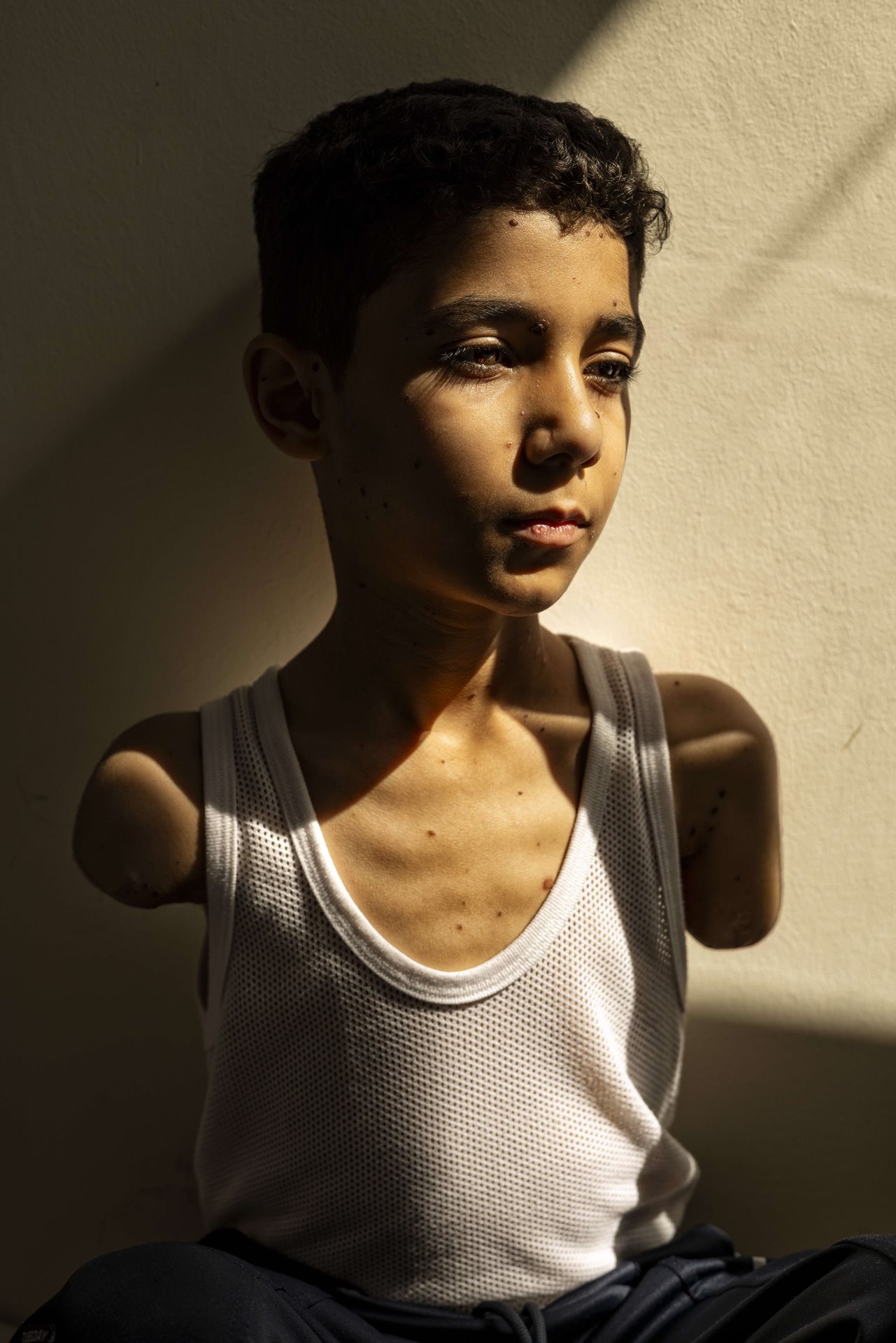
The photograph shows a mother holding up a phone displaying a picture of her daughter — round-cheeked, bright-eyed, healthy. Beside the phone, in her other arm, is the same child. The difference is devastating. Jana Ayad, photographed in Deir al-Balah in June 2024, had become unrecognisable from the girl in her mother's saved photos.
Jana's mother carried that phone image everywhere. It was proof — proof that her daughter had once been well, that the wasting was not congenital, not inevitable, but the direct result of a blockade that had turned food into a weapon. She showed it to journalists, to doctors, to anyone who would look. The 'before' photo was her evidence that this had been done to her child.
The juxtaposition between the two images — the phone screen and the living child — became one of the most shared visual documents of Gaza's famine crisis. It compressed months of deprivation into a single frame, making visible what statistics alone could not convey. A child had been healthy. A child was now starving. The distance between those two states was measured in policy decisions made far from Deir al-Balah.
Jana's case was medically typical of the crisis. Acute malnutrition in young children follows a predictable trajectory: initial weight loss, then muscle wasting, then the body consuming its own tissue. Without intervention, organ failure follows. The International Medical Corps and other organisations working in central Gaza reported seeing hundreds of cases following this progression, with treatment options limited by supply shortages.
Jana's mother had displaced multiple times with her children, moving south from northern Gaza following evacuation orders, carrying whatever food she could find. The family lived in a makeshift shelter constructed from salvaged materials. Clean water was available intermittently. Formula and supplementary nutrition for young children had largely disappeared from the market.
The image of Jana Ayad — the phone held up beside the child — travels with a question embedded in it. Not whether this happened, because the evidence is incontrovertible. But how it was allowed to happen, in full view of the international community, documented in real time by journalists and aid workers, tracked by satellite imagery and supply chain data. The answer to that question will define how this period in history is understood.